

TravelMeet
Where your next adventure begins
About
The main goal of the project was to create a social media application for solo travelers. The app was designed to provide advanced information about local attractions and opportunities to meet new friends. By sharing photos and videos, users could explore the latest information about attractions, restaurants, local sites, and tours. The objective was to create a worldwide social app that would enhance the travel experience for users.
Timeline
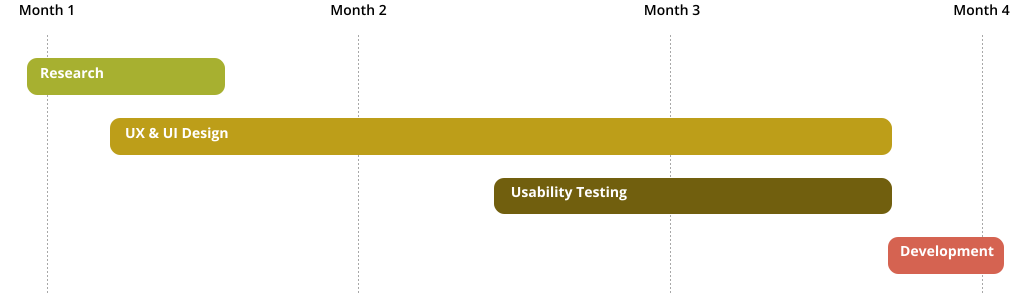
Duration
4 months
Roles
Product Designer
Brand Designer
Brand Designer
Skills
User Research, Branding Design, Wireframing, Prototyping, Usability Testing
Tools



Understanding the Problem
The travel and tourism industry is growing rapidly, surpassing the overall economy, and is expected to continue this trend until at least 2032. This sector accounts for a significant portion of global revenue. In this landscape, social media plays a crucial role, especially among Generation Z and millennials, who make up more than 50% of travellers sharing their experiences online. These tech-savvy demographics prioritize convenience and technology when planning and booking their travel.
While platforms like TikTok, Snapchat, and Instagram offer location tagging and communication features, these functionalities are not their primary focus. Moreover, their target audiences differ, and the communication options are limited to comments and direct messages. To address this gap, we propose a travel app that caters specifically to the needs of travelers by providing comprehensive location tagging and communication features.
Our app aims to serve as a centralized platform for sharing travel experiences and providing destination information, trip-planning tools, and local guides. By doing so, it seeks to enhance the travel experience for users and take advantage of the growing demand for digital solutions in the travel industry.
Research
In the research phase, our primary focus was to gain a thorough understanding of the challenges and requirements faced by travelers seeking tour information and opportunities to connect with like-minded individuals.
We carried out a survey consisting of 30 questions to gain insights from frequent travellers. After receiving 9 responses, we analyzed the data and discovered trends and patterns. The survey was crucial in helping us comprehend the main challenges travellers face and the significant features they look for in a travel application. Here are some of the key findings:
Key Findings
1.
Participants sense danger when meeting up with other users via the app.
Participants sense danger when meeting up with other users via the app.
2.
Reviews and recommendations of travel destinations including photos and videos are what most respondents enjoy seeing on travel apps.
Reviews and recommendations of travel destinations including photos and videos are what most respondents enjoy seeing on travel apps.
3.
Participants face difficulty if the information provided is not up to date.
Participants face difficulty if the information provided is not up to date.
4.
When looking for attractions at a new place participants are bombarded with a lot of information rather than getting straight to the answer.
When looking for attractions at a new place participants are bombarded with a lot of information rather than getting straight to the answer.
Key Recommendations
A.
Allow the user to type in what location they want to use instead of automatically selected based on location.
Allow the user to type in what location they want to use instead of automatically selected based on location.
B.
Allow users to activate or deactivate automatic location selection based on location.
Allow users to activate or deactivate automatic location selection based on location.
C.
Have a validation service implemented in the app to validate a person.
Have a validation service implemented in the app to validate a person.
D.
Brief descriptions of main attractions.
Brief descriptions of main attractions.
User Persona
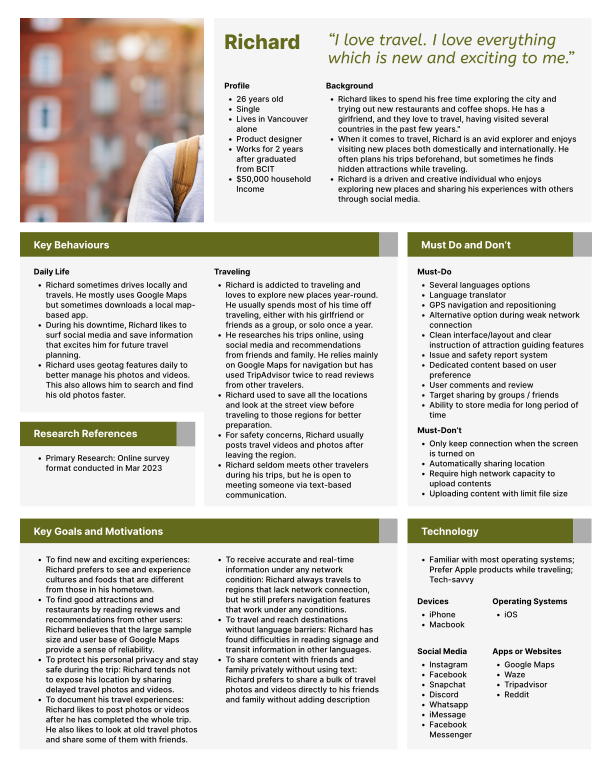
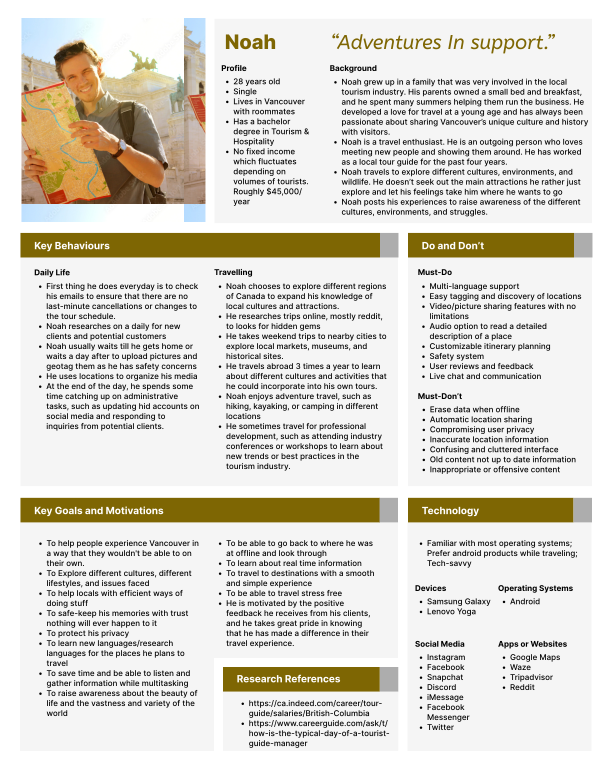
After conducting user research, we have identified two personas - one primary and one secondary. The primary persona is a travel enthusiast who loves exploring different parts of the world. The secondary persona is a local tourism worker who enjoys meeting and guiding travelers to explore the exciting locations around them.
Primary Persona
Secondary Persona
Design Decisions
Branding

We designed a vibrant, green UI and branding to evoke a sense of community and adventure for travelers. The logo features a suitcase, representing global tourism.
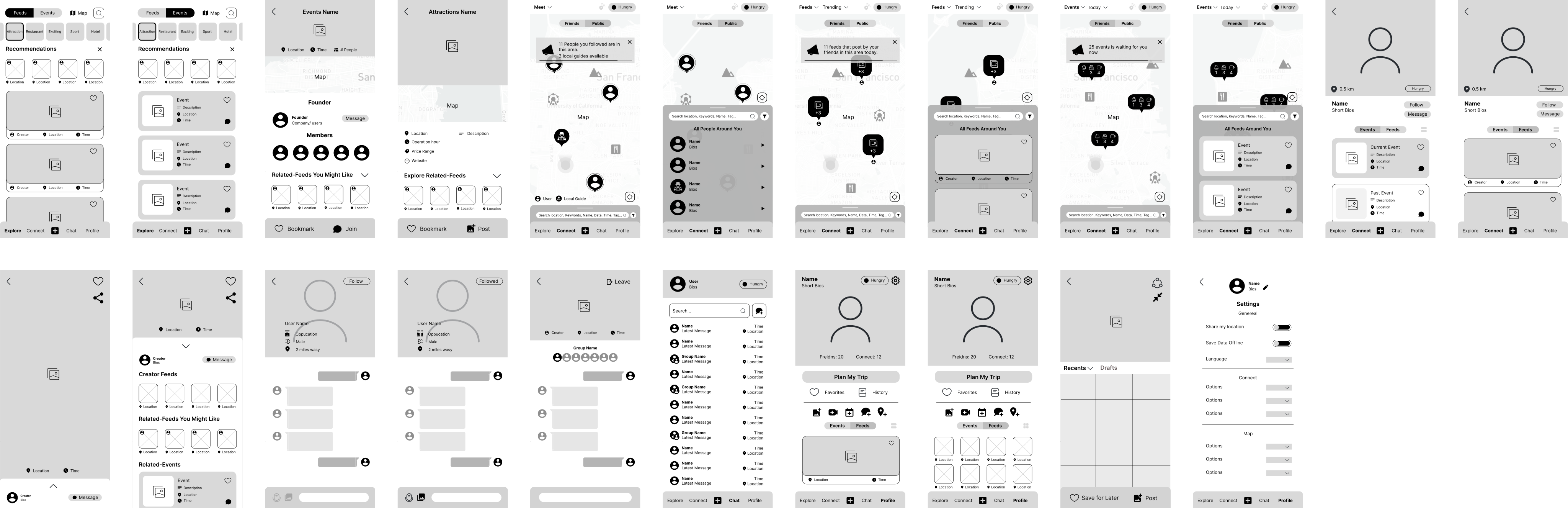
Lo-Fi Prototype
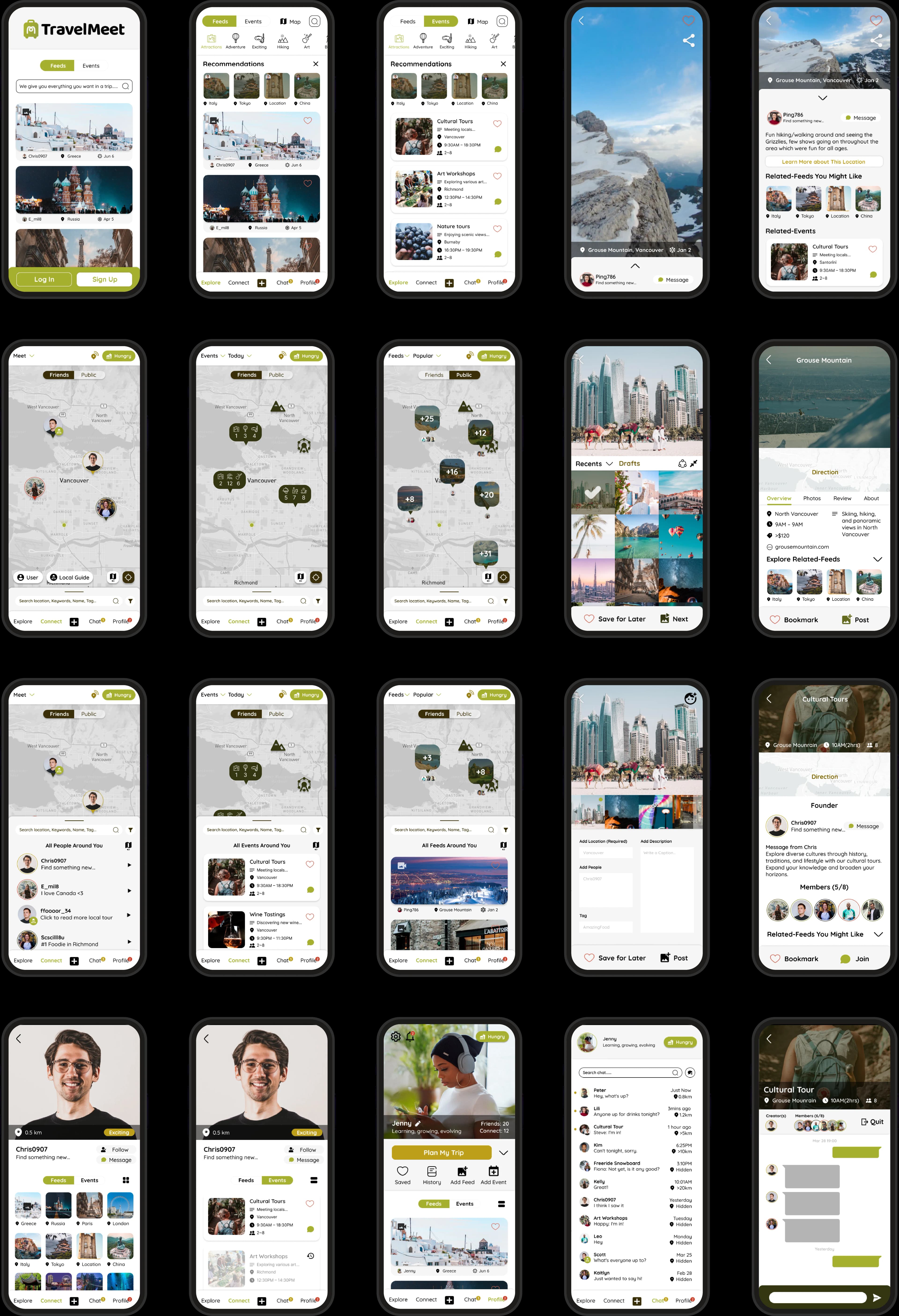
The prototype's initial design considers a traveller's significant needs and implements features to share the excitement of travel with photo and video sharing options. It combines meeting friends, map-based search, profile management, event joining and hosting, and private and group messaging.
Usability Testing
Our usability testing aimed to evaluate our prototype and identify potential issues impacting the user experience. The study was conducted with five participants who completed a series of scenarios to test the app's functionality and ease of use. Our findings revealed that participants could complete all tasks, but some had difficulties locating status features. Despite these challenges, participants had a positive overall impression of our application, particularly regarding finding and connecting with other users and planning trips conveniently. Our design has good potential but requires improvements to enhance usability and user experience. From the feedback, we discover some crucial insights in the result:
A.
Participants expressed a need for clearer indications of post types (image or video) to help them make informed decisions before clicking.
Participants expressed a need for clearer indications of post types (image or video) to help them make informed decisions before clicking.
B.
Participants reported feeling overwhelmed by the large volume of content in the "Connect" section, potentially leading to sensory overload.
Participants reported feeling overwhelmed by the large volume of content in the "Connect" section, potentially leading to sensory overload.
C.
The absence of a send button reduces usability, while the lack of event details and member count in the "Events" section diminishes user experience.
The absence of a send button reduces usability, while the lack of event details and member count in the "Events" section diminishes user experience.
D.
The small size and awkward placement of the menu make it less discoverable and physically challenging to access with one hand, impacting user interaction efficiency.
The small size and awkward placement of the menu make it less discoverable and physically challenging to access with one hand, impacting user interaction efficiency.
Hi-Fi Prototype
Final Product
Our final product aims to be engaging, attractive, and comfortable for travellers. Tourists may sometimes feel overwhelmed with all the information available and need help with outdated or incorrect information. Therefore, we have designed a clear and intelligent layout with features resembling social media apps and incorporate the best practices for a traveller's need in an all-in-one app.
What's NEXT
The design team has successfully completed the prototype and interface design work and passed it to the development team for further development. To streamline the development process, we have also created a comprehensive digital style guide, which ensures the quality and completion of final deliverables post-development.
